Here are 7 pithy, conversation-sparking statements tailored for your 4.5" teak coasters.
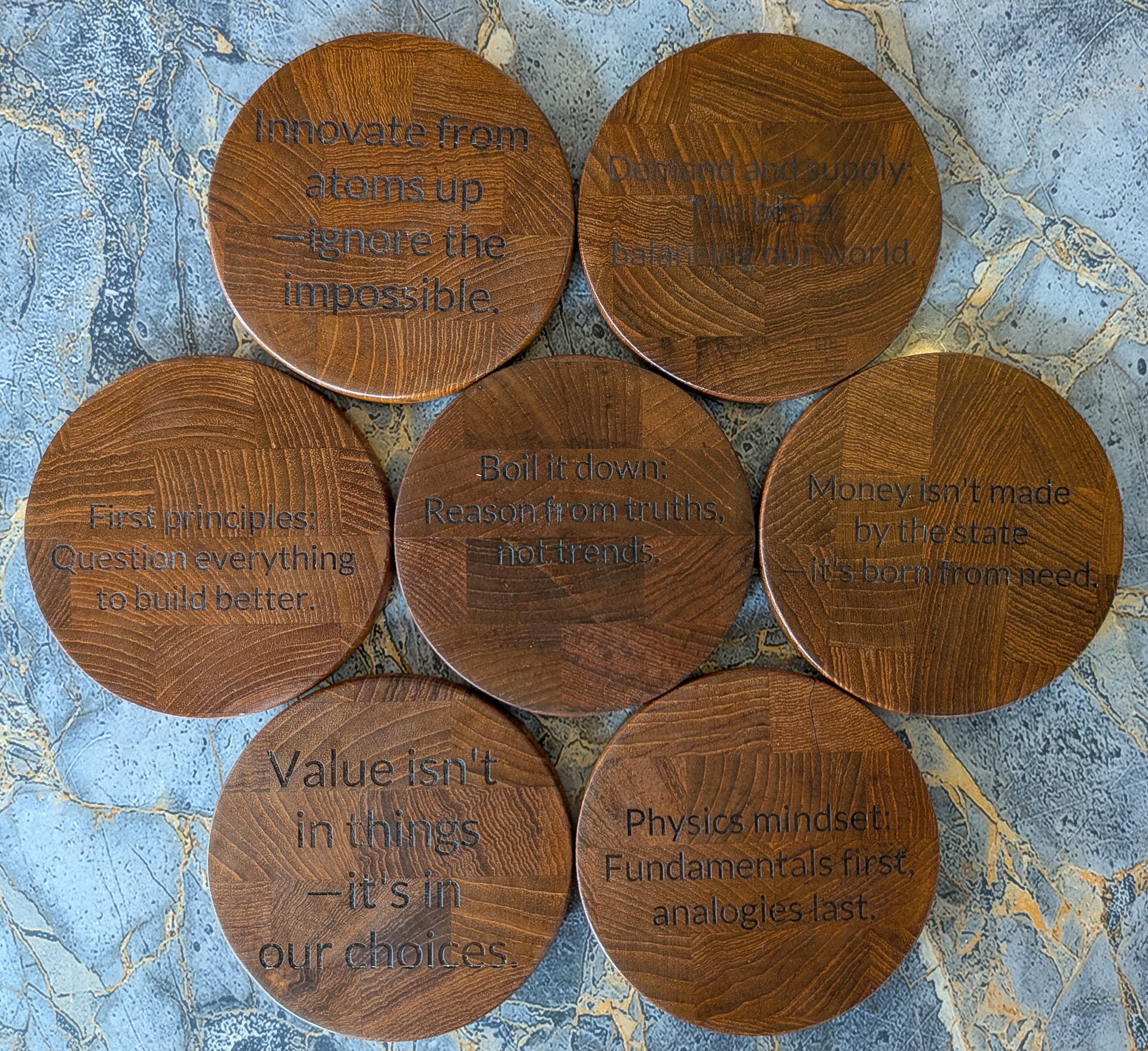
I’ve had these coasters since the middle '80s. Let’s add a bit of flair.
I’ve drawn from Carl Menger (widely recognized as the father of Austrian economics) for economic wisdom, Elon Musk for innovative flair, and a focus on first principles (a core Musk concept) to create a cohesive series. Each is short enough to engrave clearly, perhaps with a simple border or icon (like a gear for principles or a coin for economics). These can provoke debates on value, innovation, and thinking fundamentals over drinks.
-
Money isn’t made by the state—it’s born from need.
(Inspired by Menger: Sparks talk on government’s role in economics.) -
Value isn’t in things—it’s in our choices.
(From Menger: Invites discussion on what we truly prize in life.) -
Boil it down: Reason from truths, not trends.
(Musk on first principles: Challenges guests to rethink habits.) -
First principles: Question everything to build better.
(Musk’s core method: Prompts stories of personal breakthroughs.) -
Physics mindset: Fundamentals first, analogies last.
(Musk quote essence: Fuels chats on science vs. tradition.) -
Demand and supply: The beam balancing our world.
(Menger’s insight: Leads to debates on markets and fairness.) -
Innovate from atoms up—ignore the impossible.
(Musk applying first principles to rockets/batteries: Inspires bold ideas.)
- Grok
1. Money isn’t made by the state—it’s born from need.
This quote, inspired by Carl Menger’s foundational ideas in Austrian economics, emphasizes that money emerges organically from human interactions and necessities rather than being imposed by governments. Menger argued in his 1871 work “Principles of Economics” that money originates as a medium of exchange when people recognize certain commodities—like gold or shells—as widely acceptable for trade, solving the inefficiencies of barter. This challenges the notion that states create money through fiat; instead, it’s a spontaneous order arising from individual needs for efficient transactions, highlighting the bottom-up evolution of economic systems.
In practice, this concept underscores why cryptocurrencies like Bitcoin have gained traction without initial government backing—they address modern needs for decentralized, borderless transactions in a digital age. For example, in regions with unstable currencies, such as Venezuela during hyperinflation, people turned to Bitcoin not because a state decreed it, but out of sheer necessity to preserve value and facilitate trade. This illustrates how money’s legitimacy stems from its utility in fulfilling human demands, sparking debates on whether governments should regulate or merely recognize such innovations.
2. Value isn’t in things—it’s in our choices.
Drawing from Menger’s subjective theory of value, this quote posits that the worth of any object or service isn’t inherent in its physical properties but arises from individual preferences and decisions. Menger revolutionized economics by shifting focus from labor or production costs (as in classical theories) to how people subjectively assess utility based on their circumstances. This means value is dynamic, personal, and context-dependent, explaining why a bottle of water might be priceless in a desert but worthless near a stream—it’s all about human choice in allocating scarce resources.
A real-world example is the art market, where a painting like Van Gogh’s “Starry Night” holds immense value not due to the canvas and paint alone, but because collectors choose to prize its emotional and cultural significance. During the NFT boom in the early 2020s, digital artworks sold for millions despite lacking physical form, purely because buyers valued rarity and ownership in a virtual space. This invites reflection on personal priorities, encouraging discussions about consumerism and what we truly “value” in life beyond material accumulation.
3. Boil it down: Reason from truths, not trends.
Elon Musk’s advocacy for first principles thinking is captured here, urging us to break problems into fundamental truths rather than following fleeting fashions or conventional wisdom. Musk describes this as “boiling things down to the most fundamental truths and then reasoning up from there,” a method he credits for innovations at SpaceX and Tesla. It counters the human tendency to rely on analogies or herd mentality, promoting rigorous, evidence-based reasoning to uncover novel solutions in a world bombarded by hype and misinformation.
Consider how Musk applied this to electric vehicles: instead of tweaking existing car designs (a trend-following approach), he questioned basics like battery chemistry and energy density, leading to Tesla’s breakthroughs in range and affordability. An everyday example might be someone rethinking career choices—not chasing trendy jobs in tech for status, but evaluating core skills and passions to build a fulfilling path. This mindset fosters deeper conversations on breaking free from societal pressures and innovating personally.
4. First principles: Question everything to build better.
At the heart of Musk’s philosophy, this quote encourages relentless questioning of assumptions to reconstruct ideas from the ground up, enabling superior outcomes. First principles thinking, borrowed from physics and Aristotle, involves deconstructing complex issues into irreducible facts, then reassembling them creatively. Musk uses it to challenge “that’s how it’s always been done,” turning impossibilities into realities, like reusable rockets, by focusing on physics fundamentals over industry norms.
A striking example is SpaceX’s development of the Falcon 9 rocket. Traditional aerospace firms accepted single-use rockets as standard, but Musk questioned why rockets couldn’t land like planes, boiling it down to propulsion and materials science. This led to the first successful orbital rocket landing in 2015, slashing space travel costs. On a personal level, someone might apply this to health by questioning diet trends and instead studying basic nutrition science to create a tailored regimen, prompting stories of transformative “aha” moments in innovation or self-improvement.
5. Physics mindset: Fundamentals first, analogies last.
This essence of a Musk quote stresses prioritizing universal physical laws over superficial comparisons, ensuring decisions are grounded in reality rather than misleading shortcuts. Musk warns against analogies because they can perpetuate errors from flawed precedents; instead, a “physics mindset” demands starting with proven fundamentals like energy conservation or gravity, using them as building blocks for problem-solving. This approach demystifies complexity and bridges science with everyday decision-making.
In Tesla’s battery production, Musk avoided analogizing to traditional manufacturing and instead focused on atomic-level fundamentals, optimizing for electron flow and material efficiency, which accelerated Gigafactory advancements. For instance, in urban planning, one might skip comparing new cities to old ones and instead use physics basics—like traffic flow dynamics modeled as fluid mechanics—to design efficient transport systems. This fuels debates on blending scientific rigor with tradition, challenging guests to evaluate how much their views rely on habit versus hard facts.
6. Demand and supply: The beam balancing our world.
Menger’s insight into supply and demand as the core mechanism of markets is poetically framed here as a “beam” maintaining equilibrium in society. In Austrian economics, prices naturally adjust through the interplay of what people want (demand) and what’s available (supply), without central planning. This self-regulating “beam” ensures resources flow to where they’re most valued, promoting efficiency and fairness through voluntary exchanges, while critiquing interventions that distort this balance.
The housing market provides a clear example: in booming cities like San Francisco, high demand for limited supply drives up prices, signaling developers to build more—balancing the beam over time. However, zoning laws (government interference) can tip it, leading to shortages and debates on equity. During the 2020 pandemic, toilet paper shortages arose from panic demand overwhelming supply chains, but markets quickly adjusted as production ramped up. This quote sparks discussions on free markets versus regulation, questioning how “fair” outcomes emerge from individual pursuits.
7. Innovate from atoms up—ignore the impossible.
Musk’s application of first principles to fields like rocketry and energy storage inspires this call to rebuild from basic elements, dismissing perceived limits. By starting at the atomic level—literally considering materials and physics—Musk ignores naysayers who deem ideas “impossible,” focusing on what’s theoretically feasible. This mindset has driven feats like Starship’s development, where traditional barriers are bypassed through iterative, fundamental redesigns.
Take Neuralink: instead of analogizing to existing brain interfaces, Musk’s team innovated from neural biology and microelectronics basics, creating implantable threads thinner than hair to link brains with computers. An example in renewable energy is rethinking solar panels not as incremental improvements but from photovoltaic physics, leading to more efficient perovskite cells. This encourages bold ideation, inspiring guests to share ambitious dreams and debate the line between visionary thinking and reckless optimism.