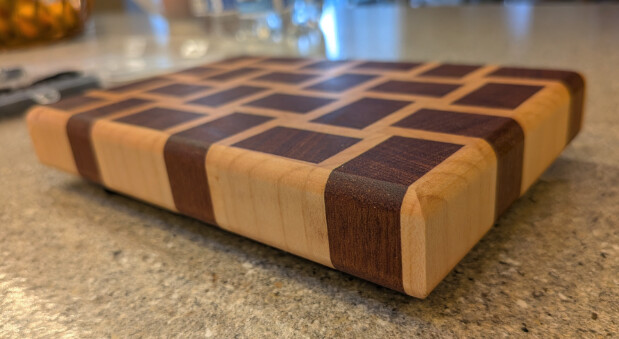
We learn by trying new things. The woods were left over from earlier projects in quantities just enough to prove a build process. These are small boards intended for use on a bar top, just large enough to cut limes.
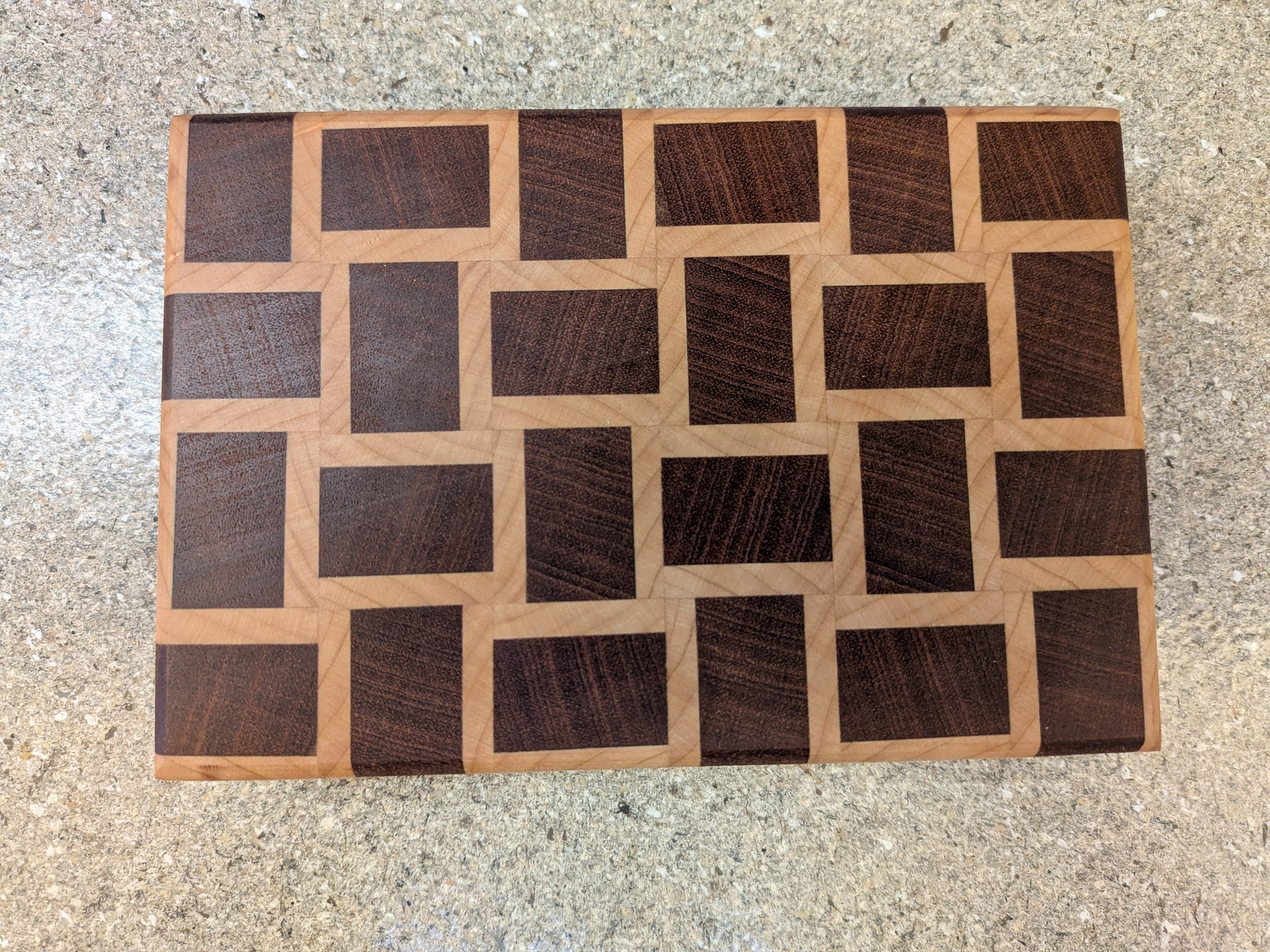
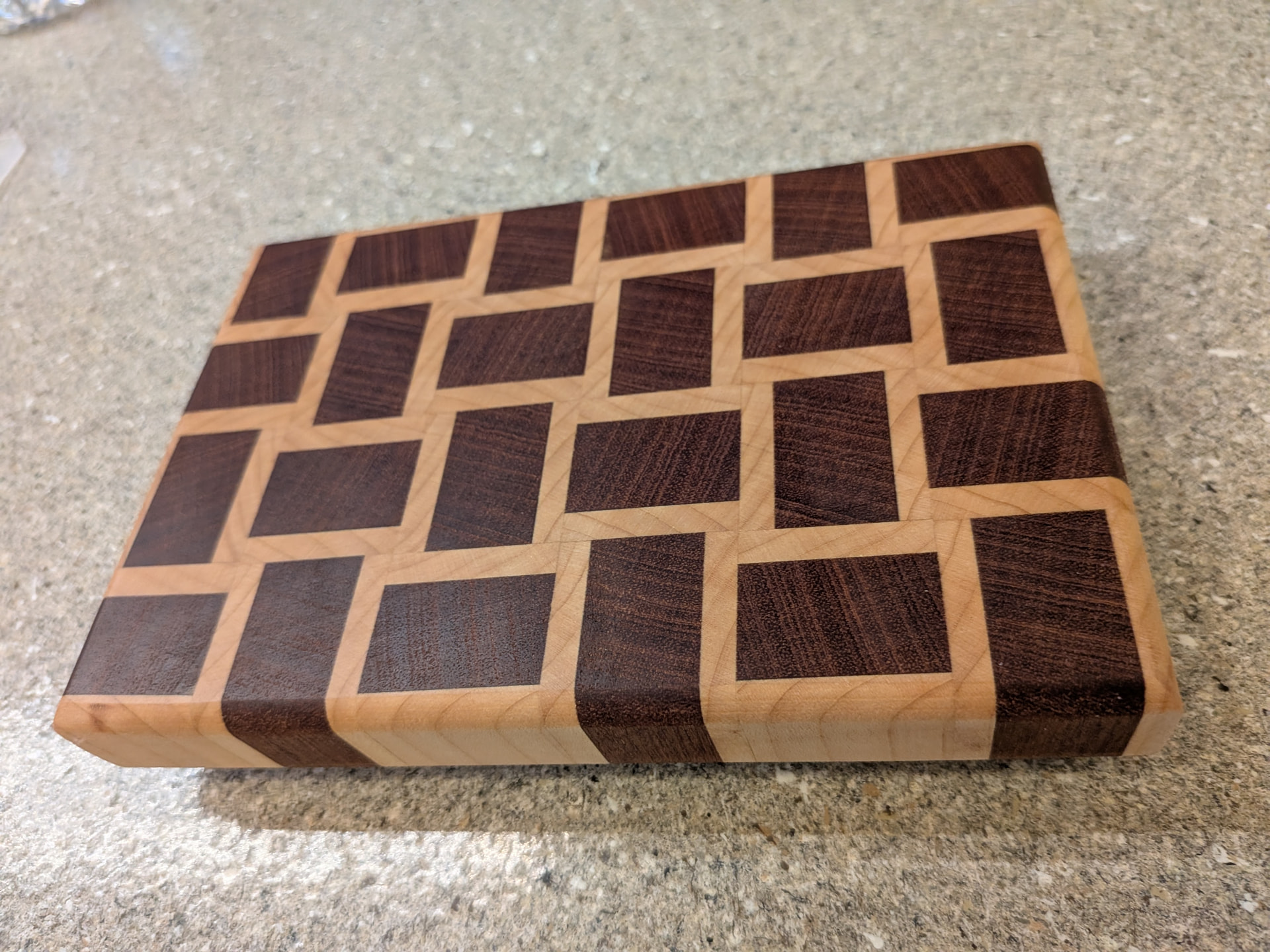
This small cutting board is made from 72 individual pieces of wood, 24 Sapele and 48 Maple.
Process:
- Glue-up 1: Make a sandwich with sapele between two thin maple strips. The composite is a perfectly square 2"x2" triplet. Example: Sapele 1.5" thick by 2.0" wide sandwiched between two maple strips 0.25" thick by 2.0" wide. Make 4 of these. Important: You need an even number for the pattern to work.
- When the glue dries, clean up each triplet, making each one square, clean, and exactly the same size.
- Glue-up 2: Rotate every other triplet. Glue all 4 together.
- When the glue dries, clean up each side.
- Calculate the strip width necessary to use as much of the material as possible. Consider the blade width. The width of the strips will become the height of the board.
- Cut cross-grain to make strips. Lightly sand each strip to remove loose material.
- Rotate the strips to have end-grain up, and flip every other strip end-for-end to create the weave pattern.
- Glue-up 3.
- When the glue dries, clean up the board with a planer and sanding.
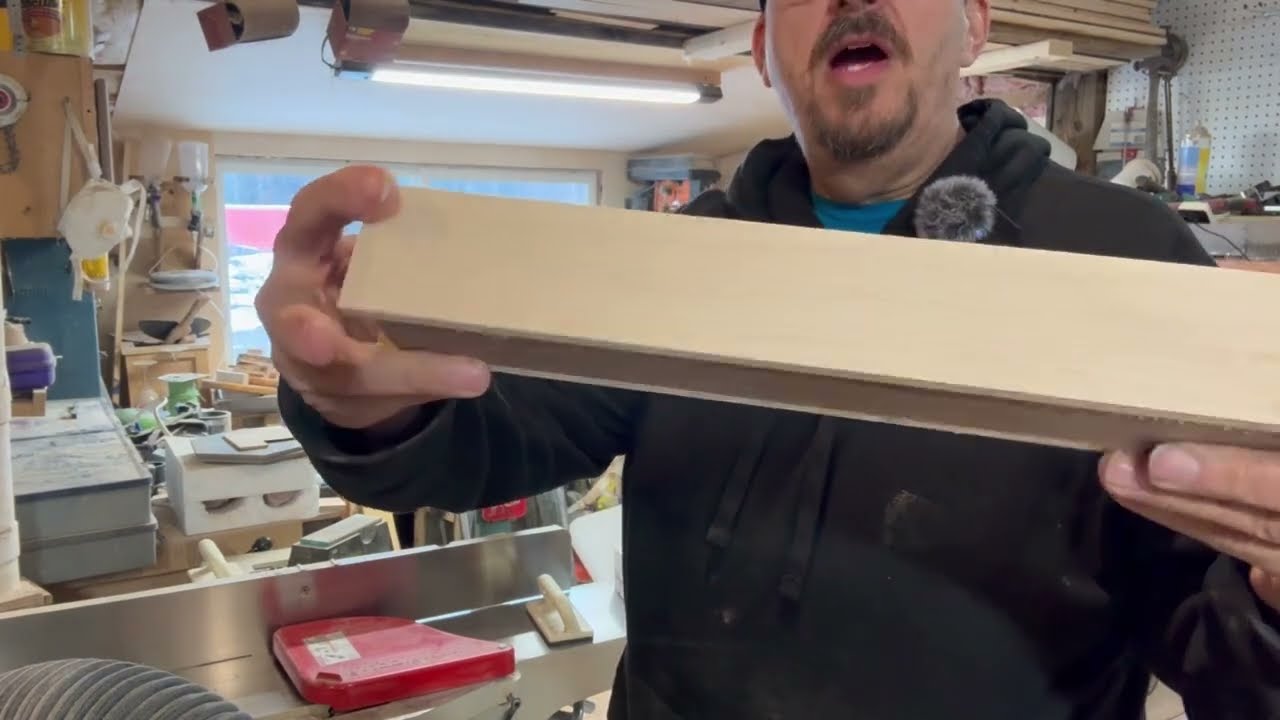
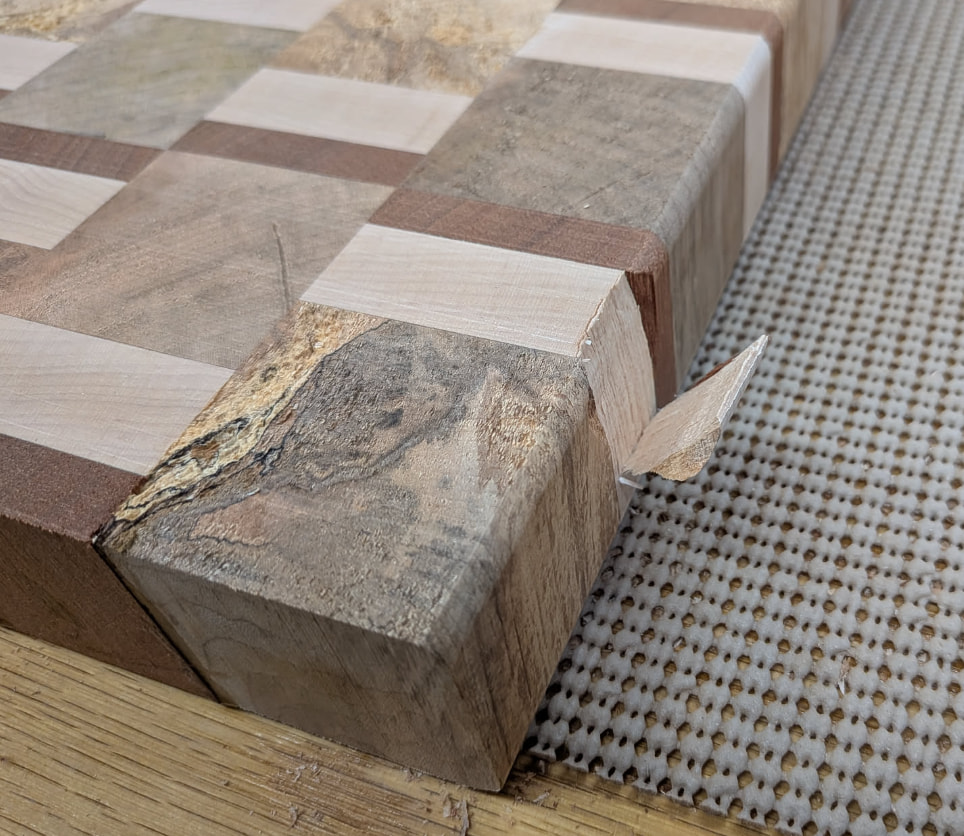
Use caution and great care when using a planer on an end-grain board. Consider avoiding the planer and cleaning up the board by sanding. If you choose to proceed, a router can be used to round over the edges to remove sharp edges that can catch a planer blade. Make gradual passes. In this photo, the white oak splintered a flake from the board, even though the edge was rounded.
- Apply butcher block conditioner and optionally install rubber feet.
Youtube Tutorial