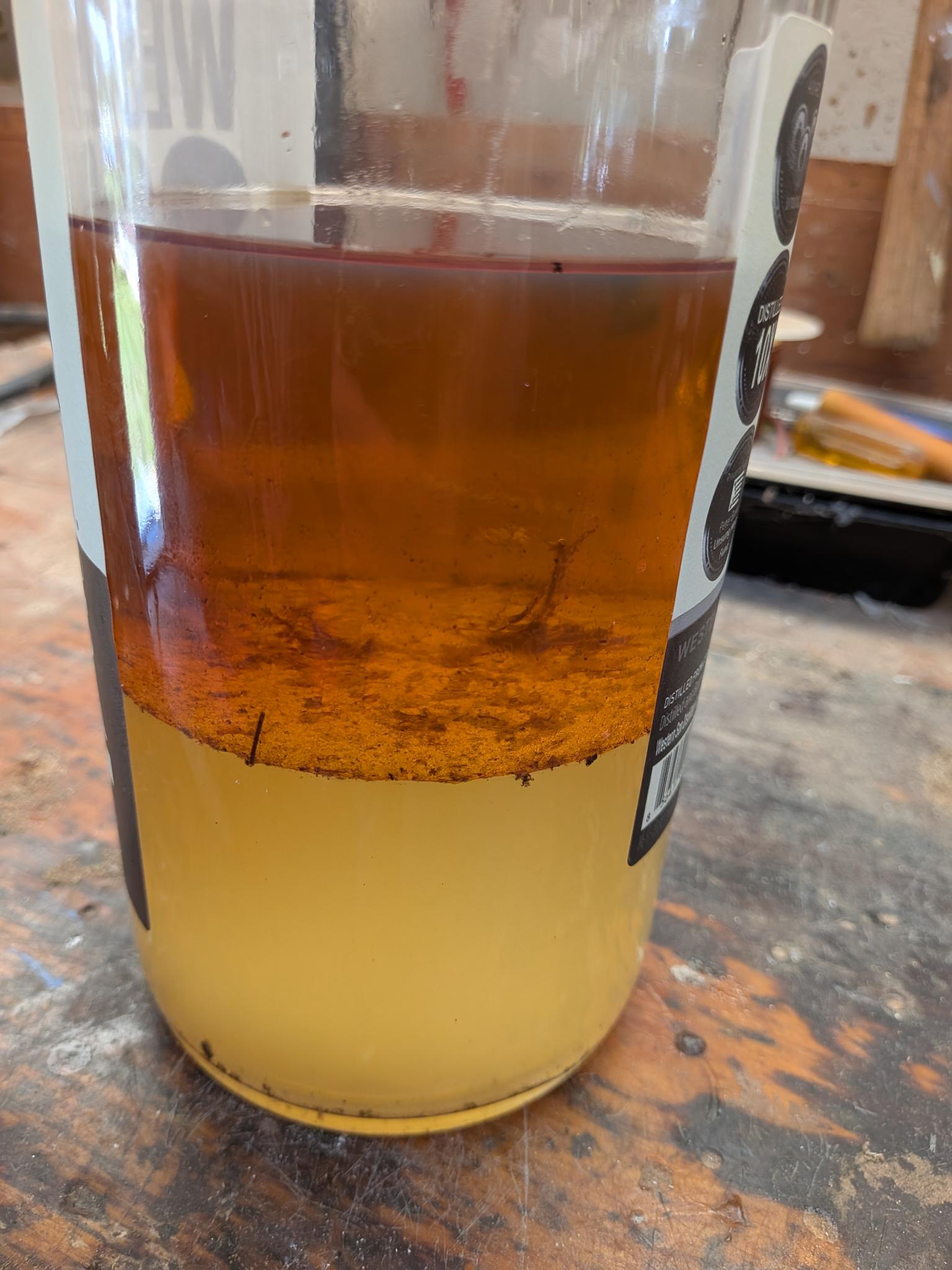
The outboard motor was running rough so I installed a clean gas tank with fresh gas. I then let the bad gas evaporate to a small portion that you see here. The AI tells me that a can of dry-gas would not have solved the problem.
This is classic phase separation of ethanol-blended (typically E10) gasoline that has absorbed water, plus significant evaporation of the light ends.
Most pump gasoline contains ~10% ethanol. Ethanol is hygroscopic—it pulls in moisture from air or condensation. Once the water content exceeds the blend’s tolerance (roughly 0.5% by volume at moderate temperatures, or only a few teaspoons per gallon), the ethanol preferentially bonds with the water and drops out of the hydrocarbon mixture. The resulting denser ethanol–water phase sinks, leaving two distinct layers.
What the layers are
- Lower (pale yellow) layer: The denser aqueous/ethanol-rich phase. It is mostly water + ethanol, plus any other polar or water-soluble material that partitioned into it. It is denser than the hydrocarbons, so it sits at the bottom. It will not burn properly and is corrosive.
- Upper (darker amber/orange) layer: The remaining hydrocarbon phase of the gasoline. Most of the ethanol has been stripped out of it, so it has lower octane. Because the original volume shrank dramatically (3 gallons → ~1 quart), the light, volatile components evaporated preferentially. What remains is enriched in heavier hydrocarbons, aromatics, and oxidation products (gums, varnishes) that give it the darker color.
The sharp interface is the visual hallmark of irreversible phase separation. You cannot simply mix or add a fuel dryer to reverse it once the layers have formed.
Why the debris sits at the upper-layer interface
The particles (dirt, rust, polymerized oxidation products, or other insolubles) are denser than the upper hydrocarbon layer but less dense than (or preferentially wet by) the lower aqueous–ethanol layer. They therefore settle until they reach the interface and accumulate there rather than sinking all the way to the bottom. Surface tension and interfacial chemistry also tend to trap fine particulates and gum-like material at the boundary between the polar and non-polar phases. That is why the debris appears “settled in on the upper level” instead of resting on the floor of the container.
In short: water pulled the ethanol out of solution, gravity sorted the two liquid phases by density, evaporation concentrated the heavier and oxidized residues into the upper layer, and the particulates parked at the density boundary between them. Both layers are unusable as fuel.