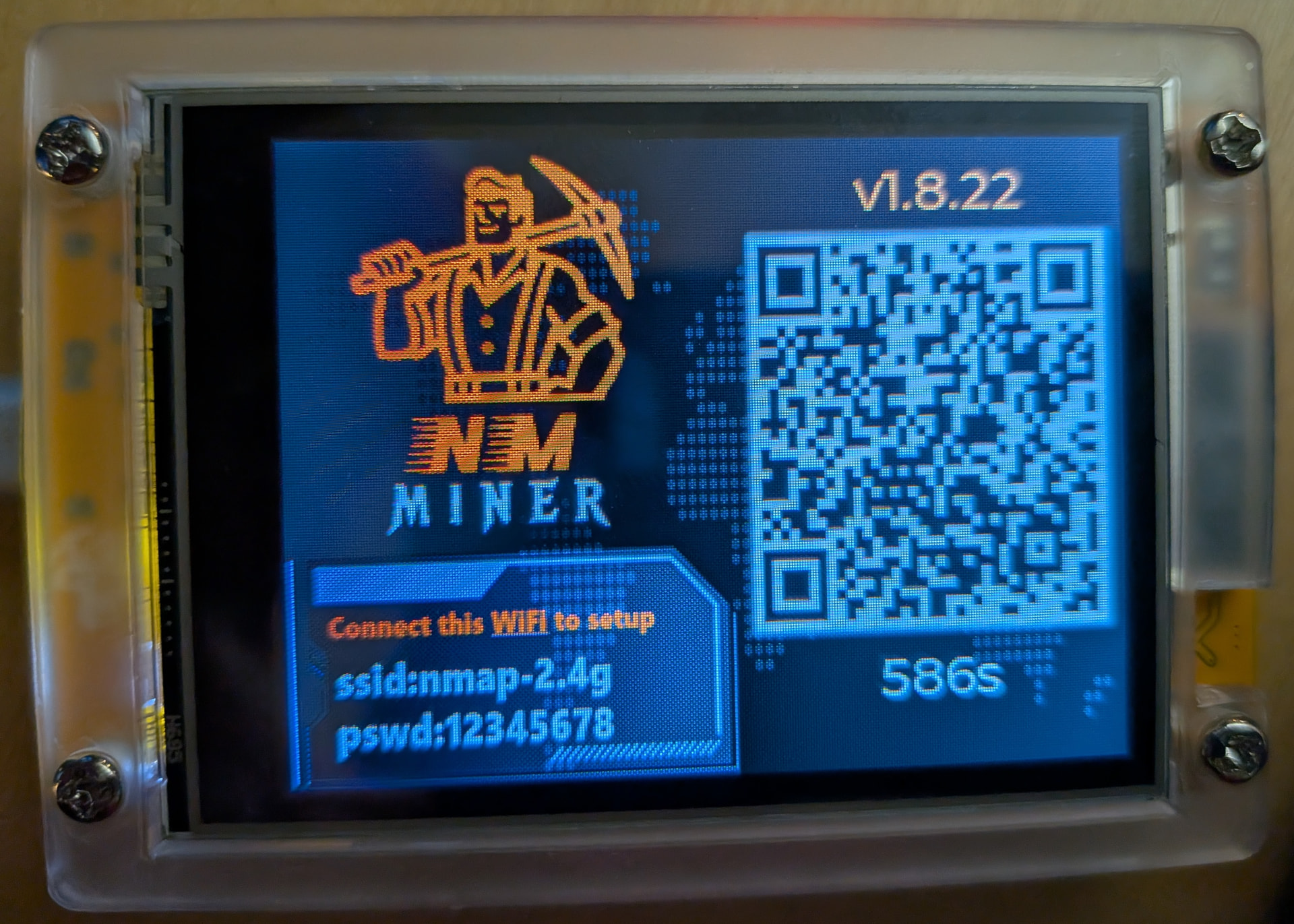
Short answer: No — not on your main LAN.
What you have is a cheap ESP32-based “NEM Miner” novelty device. These are often sold as toys or promo items, not real miners.
Why it’s risky:
- Runs unknown firmware (often closed-source, unsigned).
- Creates its own Wi-Fi AP with hard-coded credentials (shown on screen).
- No guarantee it won’t:
- Scan your network
- Phone home
- Expose services with weak/default auth
- These devices rarely receive security updates .
Safe ways to use it (if you want to play):
- Do NOT join it to your LAN
- Put it on:
- A guest Wi-Fi with no LAN access, or
- A VLAN / isolated SSID , or
- A travel router that NATs to the internet
- Block outbound traffic if possible and observe behavior.
- If you’re curious, sniff traffic with tcpdump/Wireshark first.
Reality check:
- It will not meaningfully mine crypto.
- Most just display stats or submit trivial shares.
- Treat it like an IoT toy, not infrastructure.
What is the text embedded in the QR code?
The QR code encodes Wi-Fi connection information, matching the text shown on the screen.
Decoded content (standard Wi-Fi QR format):
WIFI:T:WPA;S:nmap-2.4g;P:12345678;;
Meaning:
- SSID: nmap-2.4g
- Security: WPA
- Password: 12345678
Scanning it simply prompts a device to join that Wi-Fi network.
Does it have a private key? How do I get any Bitcoin that it mines?
No — it does not have a Bitcoin private key, and you won’t get Bitcoin from it.
Here’s what’s really going on:
1. It does NOT mine Bitcoin
- Bitcoin mining requires ASIC hardware.
- An ESP32 device cannot mine BTC in any meaningful way.
- If it claims “BTC,” it’s either:
- Fake/demo
- A pool “share submitter” earning fractions of pennies
- Just a stats display
2. No usable private key
- These devices do not generate or expose a wallet private key .
- There is no seed phrase, no address you control.
- Any “rewards” (if real at all) are:
- Sent to the manufacturer’s wallet
- Or credited to a cloud account you don’t own
3. Why it says NEM
- NEM is a different blockchain (not Bitcoin).
- Even then, real NEM harvesting requires:
- A funded account
- Delegated harvesting
- This device does neither properly.
4. How people think they get paid
- Some units point to a pool URL hardcoded in firmware.
- You cannot change payout address without reflashing firmware.
- Most never pay anything, ever.
Bottom line
- It’s a novelty IoT toy, not a miner.
- There is no Bitcoin, no private key, no withdrawal path.
If you want, I can:
- Confirm traffic destinations
- Show how to dump or reflash firmware
- Recommend real beginner-friendly crypto setups (safe + legit)