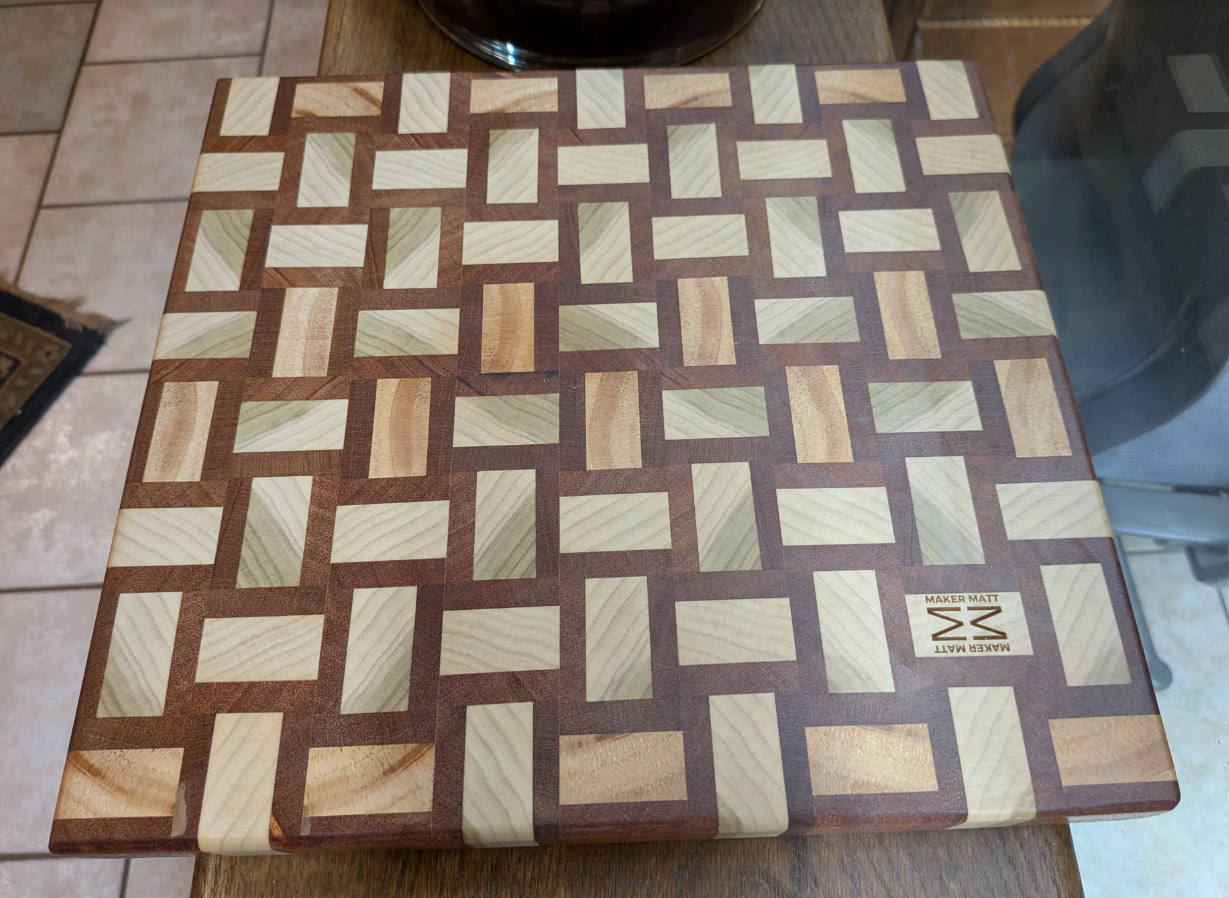
In a basketweave cutting board, the “number triplets” are a shorthand for how many strips of each wood/color are grouped together at each stage.
Think of each triplet like:
A / B / C
where each number is the strip count or unit width for the three visual bands in the repeating pattern.
1. First glue-up: make striped blanks
The first glue-up creates long striped panels.
Example triplet:
1-3-1
means:
A B B B A
So the center wood is three units wide, bordered by one unit of the other wood.
For a basketweave look, you usually make two complementary blanks:
1-3-1
3-1-3
So one blank is mostly dark in the middle, the other mostly light in the middle.
2. Second glue-up: cut strips, rotate every other strip
After the first panel is glued, you crosscut it into equal-width strips.
Then you rotate or flip every other strip so the long grain/color blocks alternate direction visually.
The logic is:
Strip 1: normal
Strip 2: rotated/flipped
Strip 3: normal
Strip 4: rotated/flipped
This makes the “over-under” illusion begin.
The triplets now describe the visible block sequence across each row. A row that was:
1-3-1
beside a flipped/rotated row becomes visually opposed by:
3-1-3
That contrast is what makes the weave.
3. Third glue-up: cut again and alternate again
After the second glue-up, you cut the board again, usually perpendicular to the previous cuts.
Then you again alternate orientation/order during the final glue-up.
The goal is to create repeating squares/rectangles where the apparent “wide” band switches direction:
horizontal wide band
vertical wide band
horizontal wide band
vertical wide band
That gives the woven checker effect.
Core rule
For a clean basketweave, the triplets should be mirror/complement pairs:
1-3-1 pairs with 3-1-3
1-2-1 pairs with 2-1-2
2-4-2 pairs with 4-2-4
The middle number controls the “fat strand” of the weave.
The outside numbers control the border/separation that makes the weave readable.
A good starting pattern is:
1-3-1 / 3-1-3
or, if you want a subtler weave:
1-2-1 / 2-1-2
The main idea: each glue-up converts long stripes into blocks, and each alternating rotation swaps which wood appears dominant, producing the over-under basket illusion.