In this post, we delve into the world of 12-volt air conditioning, exploring its efficiency and functionality in the face of unexpected power outages. We share our experiences with power management in an RV park, the challenges of maintaining electrical components in a salty environment, and the surprising resilience of our A/C unit, all while living on/off-grid in the heat of Florida.
Amazon affiliate links are used in this post. As an Amazon Associate I earn from qualifying purchases.
An Unexpected Power Outage
Sometimes, unexpected things happen. Lynn, the RV park manager, had warned us about the 30/50 amp service. Her electrician had advised her not to replace electrical components that hadn’t failed yet. In the salt air, just feet away from the Gulf of Mexico, electrical components don’t have a long lifespan, and they are expensive.
Sure enough, on site 25-A, the 110 circuit was out. Fortunately, site 25-B was working, at least for the time being. It would operate from about 10:20 PM when we got back until 3:18 AM when the breaker… broke. After that, we were reliant on the batteries.
I woke up before sunrise, thinking this was a nice quiet time to get some work done. Noticing the A/C was cycling nicely, I decided to collect some data. The first thing I noticed was that the battery bank was down to 92%, which was when I realized the shore power was out.
Although the power cord is of a heavier type and can handle a large amount of current, it’s not very long. I had set the Victron Multiplus II charge limit at 15 amps to put less stress on the campground power grid. If necessary, I can reduce this to 10 amps. 10 Amps times 110 volts equals 1,100 watts, more than enough to power the A/C. When the A/C is off, all the power will go to recharging the batteries.
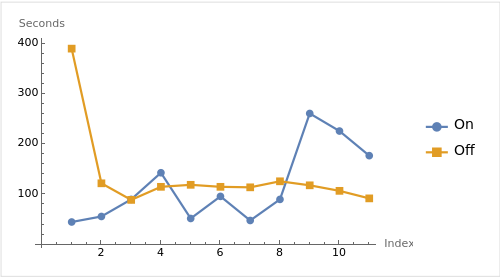
In an unscientific manner, I timed a few On/Off cycles. A former co-worker once said, “all data is flawed, some data is useful”.
| State | Seconds | State | Seconds |
|---|---|---|---|
| On | 0:45s | Off | 6:30s |
| On | 0:56s | Off | 2:02s |
| On | 1:30s | Off | 1:29s |
| On | 2:23s | Off | 1:55s |
| On | 0:52s | Off | 1:59s |
| On | 1:36s | Off | 1:55s |
| On | 0:48s | Off | 1:54s |
| On | 1:30s | Off | 2:06s |
| On | 4:21s | Off | 1:58s |
| On | 3:46s | Off | 1:47s |
| On | 2:57s | Off | 1:32s |
| Average On | 1:45s | Average Off | 1:56s |
Understanding the A/C Unit’s Efficiency
The air conditioning (A/C) unit tends to be switched off slightly more often than it is switched on. While operating, it typically consumes around 800 watts of power. However, given that it’s not running more than half the time, its average power usage is less than 400 watts.
Our battery bank has a capacity of 9,600 watts. Based on these figures, it’s theoretically possible for the A/C unit to operate for a full 24 hours using only the power stored in the battery bank, thus functioning off-grid.
However, it’s important to note that these conclusions are based on a 3-hour test, which may not provide a comprehensive understanding of the A/C unit’s power consumption patterns. Therefore, more extensive testing would be necessary for a more accurate assessment.
Factors Contributing to Efficiency
How is this possible? There are a couple of factors:
- Power Efficiency: The A/C system is designed to be power efficient and run on 12 volts DC. It’s from Pro Air, a company that makes mini-split units for emergency response vehicles.
- Internal Door: The van has an internal door that splits the air volume of the RV in half. The A/C unit is in the back half, which is well insulated and has no windows.
Conclusion
Despite unexpected power outages and challenging conditions, the 12-volt air conditioning system proved efficient and resilient. The experience underscores the potential of such systems for sustainable off-grid living, especially in hot climates. Further formal experiments will provide more data, enhancing our understanding of these systems’ performance and efficiency.